

There are probably many parts in your vehicle that you don’t think about on a daily basis. Some of these parts take the brunt of the wear and tear that typically comes along with everyday driving. Parts that really take a beating day in and day out, like wheel bearings, are often overlooked. However, you’ll want to know the signs of a bad wheel bearing and replace it before it affects the quality of your ride. Let’s talk about what wheel bearings are and how they play an important role in how you travel. You’ll also want to know what signs to watch for if something is amiss.
What Are Wheel Bearings?
Wheel bearings may not be the biggest parts in your vehicle, but they certainly have a huge job to do. They connect your vehicle’s wheel hubs to its axles, allowing them to turn freely while also supporting your vehicle’s weight. The bearings enable your wheels to spin around a stationary axle with little to no friction. Not only do they allow your vehicle’s wheels to spin, but they are also responsible for ensuring a safe and controlled ride, as your car’s steering and suspension system relies on these components to do their job properly.
Typically, wheel bearings consist of small balls or cylindrical rollers, encased in a set of metal rings. Although there are many variations of wheel bearings, these are the components that most bearings consist of. These balls or rollers are encased in grease in these metal rings, also called a race, and are placed on each wheel’s hub. There may be up to 20 small balls or rollers inside this encasement, working to ensure that your vehicle’s wheels rotate properly and allow you to travel forward safely and accurately.
As with any part in your vehicle, wheel bearings succumb to wear and tear over time. However, the rate and severity will depend on your driving habits. Typically, you can expect wheel bearings to last up to 100,000 miles and beyond, but this isn’t the case for every driver. Those who frequently find themselves on rough terrain or taking on challenging loads in their work trucks, for example, will most likely need to replace their wheel bearings sooner than someone who casually drives to work each day. Since replacing them isn’t a one-size-fits-all approach, it’s important to know the telltale signs of when they need to be replaced.
When to Replace Your Wheel Bearings
Your vehicle’s wheel bearings may be low maintenance, but when they need to be replaced, you’ll know, especially if you pay attention to how your car is handling and the quality of your ride. Some drivers may be more in tune with this than others, but there are signs that your wheel bearings will give that you won’t want to ignore. Let’s talk about some common signs that your wheel bearings need to be replaced.
Noises & Vibrations
Any type of weird noise that starts to emanate from your vehicle deserves to be investigated. A humming, squealing, or popping sound may be your wheel bearings trying to get your attention. If you notice the sound getting louder as your vehicle speeds up, this is a good indicator that it’s your wheel bearing. You may also notice that your steering wheel is starting to vibrate, especially when you hit higher speeds. You won’t want to ignore these signs, especially since noises are some of the most common indicators of bad wheel bearings.
Abnormal Tire Wear
If you notice that your tires are wearing unevenly, this may be a sign that your wheel bearings are going bad. A bad wheel bearing can cause the wheel to wobble. You may not feel this at first, but it can cause abnormal wear to the tire tread. If you suspect something is amiss with your wheel bearings, the best thing you can do is inspect all of your tires and check for uneven wear.

Wobbling Wheel
This is something that can be best seen, or rather felt, when you have your vehicle up on a lift. Wheels are not meant to move when shaken, so if you can feel the wheel move when you wiggle it, it is likely due to a bad bearing. On the front wheels, a worn ball joint or tie rod can also cause it to wobble. Shake the wheel from side to side, as well as up and down. If it wobbles in both directions, a worn wheel bearing is the most likely cause.
Warning Light Illuminated
Modern vehicles are more likely to let us know when something is wrong than older models. A traction control or anti-lock brake system warning light on the dashboard is never a good sign, often indicating something is wrong with these critical safety systems. Occasionally, it can be yet another sign of worn-out wheel bearings. The wheel may be wobbling in ways that confuse wheel speed sensors that enable ABS and traction control to function, causing it to give up and turn the warning lights on instead.
Veering or Pulling to One Side
When you hold the steering wheel straight, you may notice that it pulls to one side or veers slightly, especially when you brake hard. This could mean a number of things, and a bad bearing is one of them. Although this could also be because of a bad brake caliper, you’ll want to check your wheel bearings if you notice some of the other signs mentioned above.
Loose Steering
The way your vehicle steers can tell you a lot about the inner workings of your car. Another sign that your wheel bearings may be worn is if you notice that steering feels less accurate and not as controlled as you’re used to. Any type of steering wheel pulling, vibration, or lack of responsiveness requires immediate attention, as this can affect the safety of your ride.
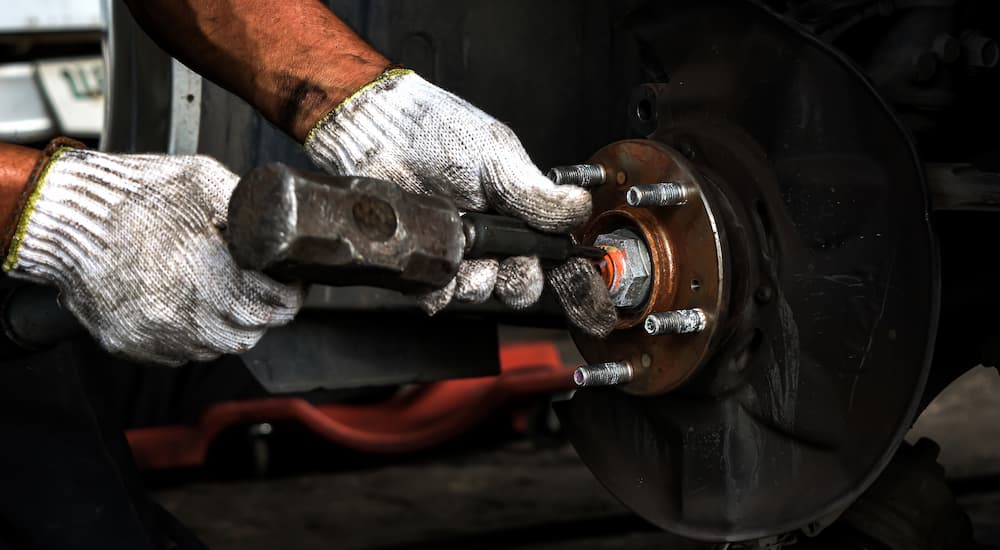
Checking for Worn Wheel Bearings
One of the easiest ways to check for a bad bearing is by feeling your wheel hub and lug nuts after driving. If they feel excessively warm, it may mean that too much friction is building up due to the bearing not doing its job properly. You’ll also want to pay attention to any noises your vehicle makes on the open road. If you have a jack and jack stands at home, you can lift the wheels off the ground, support the vehicle safely on jack stands, and chock the wheels so it can’t roll away. Release the parking brake, put the transmission in neutral, and spin the wheel. If it doesn’t roll smoothly or makes grinding sounds as it spins, you probably have a worn-out wheel bearing. Shake the wheel from side to side and up and down as described above to pinpoint the issue further.
Your wheel bearings play a key role in traveling safely. Ignoring the signs that something is wrong is a recipe for disaster, which can affect your safety and those traveling around you. Some drivers may feel confident in tackling a wheel bearing replacement on their own, but if you don’t have the right knowledge or equipment, you’ll want to trust this to the professionals.