
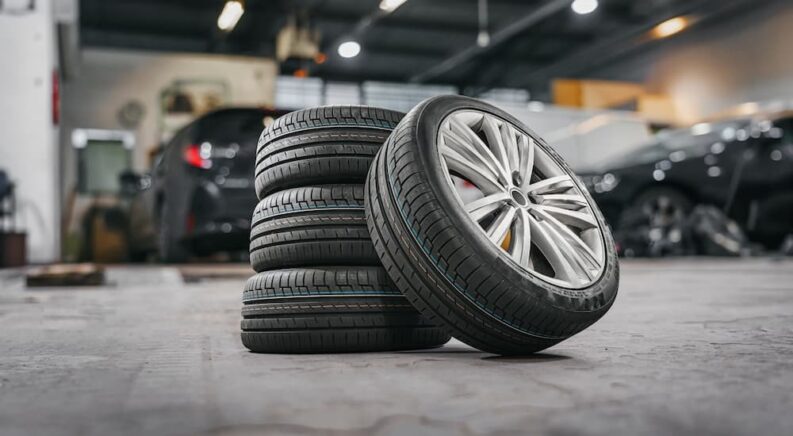
Few things feel more devastating than being stuck on the side of the road with a flat tire, especially in the middle of the night with no cell phone service. (Yes, it’s happened to me.) Trying to change a tire or arrange a tow truck can be time-consuming, expensive, and potentially life-threatening. Even if you can change the flat tire, you never quite feel secure driving on the “donut spare” that comes with most modern cars, if they come with any spare tire at all. Instead, you’re limping along main roads and highways, which creates its own perils.
It doesn’t necessarily have to be that way, though. Run-flat tires have been around for decades to help you make it to a safe location. That way, a flat doesn’t completely ruin your day or put you in danger. In recent years, self-sealing tire technology has also gained traction. Although technically a type of run-flat tire, these shoes are so distinct that they’re often discussed separately.
Are you considering buying a vehicle with run-flat tires or getting them as an aftermarket option? This guide looks at how run-flat and self-sealing tires work, followed by the benefits and drawbacks of each, so you know whether they’re worth the investment and which you should choose.
What Are Run-Flat Tires?
In any design, the idea of a run-flat tire is that it can be driven on even if it suffers a puncture. Most traditional run-flat tires are best described as self-supporting tires, reinforced to maintain some structural integrity after losing air pressure. The technology dates to 1934 when Michelin created a tire with a safety rim and a foam liner for use on military and specialty vehicles. The following year, another version was introduced with a fabric inner tire.
Various versions followed over the decades, including a high-pressure inner liner co-developed by Goodyear and Chrysler in the late 1950s. This “tire within a tire” became standard on the NASCAR circuit as a safety measure against blowouts on high-speed tracks. The first passenger vehicle to offer run-flat tires as an original equipment option was the 1973 Rover P6 3500 with Dunlop Total Mobility Tires.
Today, the two most common methods of constructing self-supporting tires are with a stiffer sidewall or a support ring system. They can only legally be used on vehicles with tire pressure monitoring system (TPMS) sensors, as this is what alerts the driver to a puncture. Many automakers now include self-supporting tires as a standard feature, particularly luxury and performance models from BMW, Audi, Lexus, Chevrolet, and MINI. Run-flats are also common on EVs because most electric vehicles don’t come with spare tires. There isn’t enough space for them due to the battery.
Pros and Cons of Run-Flat Tires
There are many good reasons to use run-flat tires on your car, SUV, or truck. In the immediate aftermath of a puncture, a vehicle with self-supporting tires will be more stable and easier to control, thus reducing the risk of a crash. Then there’s the obvious, that you won’t be stuck trying to swap tires or waiting on help in a potentially dangerous situation. A quick internet search will bring up dozens of stories about people getting injured or killed trying to change a tire on the side of the road, demonstrating how risky this is.
Instead, you’ll be able to drive the vehicle to a tire shop, your driveway, or any other location you need to, even if there’s some damage to the sidewall. The industry standard is that once punctured, most run-flat tires can be driven up to 50 miles at speeds up to 50 mph, helping you keep up with normal traffic. The main advantage is that you won’t need a spare tire on board. This reduces weight for better fuel mileage, and if the spare is normally kept in the trunk, you’ll have more room for other cargo.
That said, there are a few potential downsides. One is that run-flat tires are more expensive and may require some shuffling to fit your budget. The counterargument is that when it comes to safety, money should be no object. A bigger issue is that the selection and availability of run-flat tires aren’t as extensive as that of conventional tires. There might simply not be a set of run-flat tires available in the size, tread type, and compound that you need.
Performance-wise, the reinforcements on a run-flat tire often result in a harsher, noisier ride, especially on bumpy roads. Vehicles that come from the factory with run-flat tires have a retuned suspension to account for this, but you’ll need to be aware of this effect if you’re swapping regular tires for run-flats. Also, keep in mind that sometimes, the damage from a puncture or blowout is so catastrophic that even a run-flat tire can’t keep going. As such, always have a backup plan, such as including roadside assistance on your car insurance policy.
What Are Self-Sealing Tires?
This is a newer development in run-flat technology that considers what if a tire didn’t go flat in the first place? A self-sealing or self-healing tire has a special flexible compound covering the inner surface. If a small object, such as a nail or screw, pierces the tread, air pressure forces the compound into the hole and seals it as you drive. The material remains viscous even in extreme temperatures.
Modern self-sealing tires first appeared in the 1970s and started gaining popularity in the mid-1990s. Today, several major tire manufacturers offer self-sealing tires, including Michelin, Hankook, Bridgestone, and Continental. They are standard equipment on a variety of vehicles, including the Acura ZDX, Ford Explorer, Cadillac LYRIQ EV, Chrysler Pacifica, and the upcoming Chevy Bolt reboot.
Pros and Cons of Self-Sealing Tires
Along with having the same basic benefits as regular run-flats, self-healing tires have the bonus of not needing to change or patch the tire as soon as possible, or change your driving style in the meantime. In many cases, you can continue driving the vehicle as normal for weeks, months, or even years after a puncture, though you should periodically use the TPMS to confirm the tire is still holding air. Furthermore, the handling characteristics of a self-sealing tire are closer to those of a conventional tire, so you can swap them without significantly affecting ride quality.
Like self-supporting tires, though, self-sealing tires have limitations. The sealing compound is only intended to work on small holes, typically 5mm or less. It is also not effective on the sidewall of a tire. If the tread suffers a larger gash, or the sidewall suffers a cut or puncture, you’ll still need a spare tire to avoid being out of commission. Also, self-sealing tires are even more cost-prohibitive than traditional self-supporting tires, and availability is even more limited.
Playing It Safe on the Road
If run-flat tires are available for your vehicle, you should seriously consider them. According to the NHTSA, over 11,000 tire-related accidents happen in the U.S. every year. A set of run-flats will reduce your chances of being part of this statistic, and they can save you a lot of headaches.
Which type of run-flat tires should you choose if both are available? Get self-sealing tires if you want better driving comfort and are mainly concerned with protection from minor punctures. Go with self-supporting tires if you want extra assurance against larger blowouts, are on a lower budget, or want more tread and size options. Either way, you’re investing in peace of mind against the hazards you encounter on the road.