
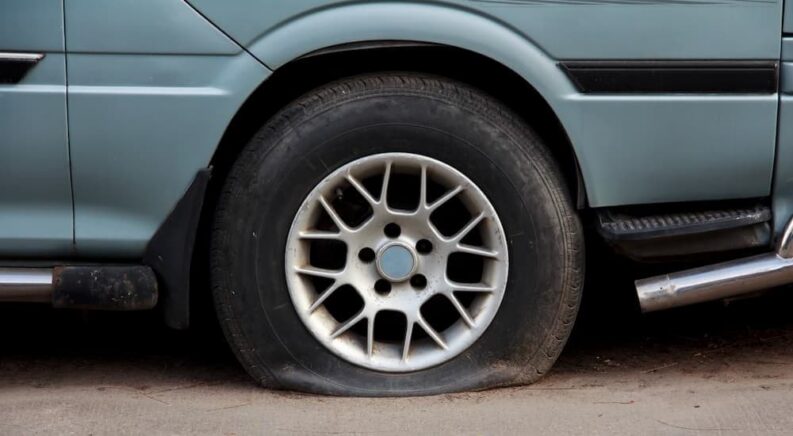
For most of automotive history, drivers followed a pretty simple process when encountering a flat tire. You’d simply pop the trunk, locate the spare, jack the car, and do a little roadside replacement. That old routine is quickly changing as more brands decide to ditch the standard spare in favor of patch kits, run-flat tires, and other solutions designed to save weight, space, and production costs.
This can lead to anxious moments when you find yourself stranded on the side of the road, but knowledge is power in preventing common worst-case scenarios and in enjoying a quick, safe tire change. Before you find yourself struggling with a lug wrench or placing a potentially expensive call to a roadside assistance service, let’s take a few minutes to brush up on some spare tire basics. We’ll address four key questions about spare tires, including where to find them, what types you might encounter, and basic maintenance tips.
Do All Cars Have Spare Tires?
We’ll start with the most obvious question of all: Does your vehicle actually have a spare tire? While a spare tire was once par for the course on almost every new passenger vehicle, it’s becoming rarer on today’s market. In fact, only 9% of the vehicles tested by Consumer Reports since 2020 are equipped with a full-size spare, while 46% were paired with a temporary “donut” spare.
While this might sound like a classic case of shrinkflation, the unfortunate trend where companies reduce the size or quantity of features of a product without lowering the price, that’s only part of the story when it comes to the case of the missing spare. Skipping out on a spare allows automakers to save anywhere from $150 to $300 on a full-size replacement and $50 to $150 on a donut.
However, the trend really boils down to a skill issue. Younger drivers are increasingly unfamiliar with the ins and outs of the old spare tire shuffle. One AAA study found that around 20% of U.S. drivers can’t change a flat tire, while 25% would rather call a roadside assistance service. Simply put, if customers aren’t equipped to change their tires, automakers aren’t about to waste money by including a spare.
Advances in automotive engineering have also contributed to the disappearance of the donut. The large battery packs that power new hybrid and all-electric models tend to take up a lot of space, which leaves little room for a spare. Other features like lower load floors and fold-flat rear seats also gobble up usable space, not to mention the constant demand for extra cargo capacity.
Finally, there’s the efficiency factor. A spare tire certainly isn’t the heaviest component you’ll find on a car, truck, or SUV, with even a full-size spare for a full-size truck or SUV weighing in at around 60 lbs, but it can still make a noticeable difference in terms of fuel economy. Brands are always striving to meet strict emissions standards, and even something as seemingly inconsequential as a spare tire can make a difference in passing muster. Curb weight is also an important consideration in the all-electric segment, where a subpar driving range is often a dealbreaker.
Where to Find Your Spare?
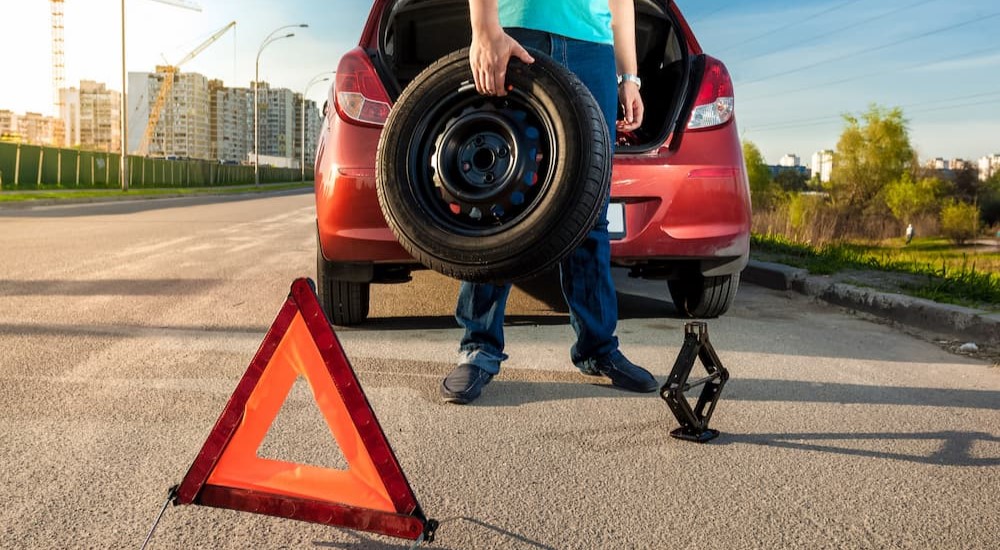
If you’re searching for your spare, assuming your vehicle is equipped with one, the rear cargo area or trunk is usually your best bet. In most sedans and hatchbacks, the spare can be found in a recessed compartment beneath the trunk floor. It’s largely the same story for most crossovers and SUVs, though some larger models might have the spare tire mounted underneath the vehicle.
This underbody storage approach is pretty much par for the course in the pickup segment, though some high-performance and off-road models, like the Ram 1500 TRX and Ford F-150 Raptor, are available with a spare mounted in the cargo bed. The rear tailgate was once a popular location on many SUVs, though that design has fallen out of favor as automakers look to improve aerodynamic appeal and embrace the convenience of upward-opening hatches.
Then there are sports cars. There’s not a lot of real estate for a spare tire when you’re in a low-slung coupe, which is why so many performance models eschew the extra tire altogether. Many sports cars rely on run-flat tires and patch kits, two common alternatives to the typical spare.
What Are the Different Types of Spare Tires?
As we mentioned earlier, there’s no universal design for a spare tire. If your vehicle is one of the 55% that are equipped with a spare, it’ll probably be one of three types. Let’s outline the differences between these designs and explore a few of the newer products that have replaced the humble spare.
Full-Size Spare
The full-size spare represents the gold standard of replacement tires. This spare tire is identical to the ones you’ll find at each corner of your car, mounted on an identical wheel, providing drivers with a plug-and-play solution for a sudden blowout or flat. You can treat the full-size spare just like a normal tire, which means there are no restrictions on speed, distance, or weight aside from what’s already outlined in your owner’s manual.
Temporary Spare
Commonly known as a “donut,” a temporary spare tire is significantly smaller and lighter than the tire that your vehicle was designed for. In addition to being 30% to 50% lighter than the standard spare, a donut is usually around 25% smaller, which means it can’t handle the high speeds of normal use.
For this reason, a temporary spare should be treated as just that, a temporary solution to a flat designed to get you to the nearest service station or tire shop. While designs vary by vehicle, most manufacturers recommend following the 50/50 rule, which advises drivers not to exceed 50 miles or 50 mph when using a temporary spare.
Full-Size Temporary Spare
As the name implies, a full-size temporary spare occupies the middle ground between a true one-for-one replacement and a donut. While it’s larger than a typical temporary spare, it’s often made from less robust materials, limiting its long-term use.
Mileage limits are a little more lax when it comes to a full-size temporary spare, but you’ll still want to keep your ride at a lower speed and use a little more caution when encountering challenging road conditions. If your vehicle is equipped with AWD or 4WD, a full-size temporary spare can cause drivetrain issues if used for more than a short time, and should be replaced with a new tire as soon as possible.
Run-Flat Tires
A run-flat tire isn’t a spare, but it’s becoming a popular alternative to the extra tire mounted in your trunk. These tires are crafted with a reinforced construction that allows them to support the vehicle’s weight even after losing air pressure. Reinforced sidewalls and rigid interior rings allow drivers to limp their way home or to their trusted local mechanic or dealership, but there are some limitations. Like a temporary spare, run-flat tires are usually limited to 50 miles and speeds of less than 50 mph.
Tire Mobility Kits (TMK)
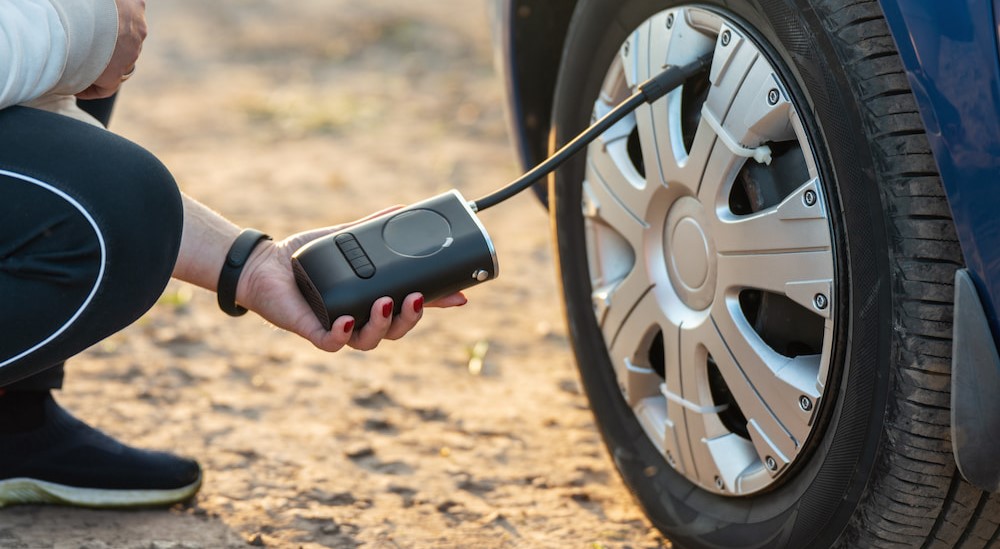
While some luxury and performance vehicles have adopted run-flat tires, more and more models are eschewing a true spare in favor of tire mobility kits (TMKs). Also known as patch kits, TMKs allow drivers to do a little roadside repair without having to wrestle with a tire iron and scissor jack. These TMKs usually consist of a bottle of tire sealant and a small air compressor. Simply connect the compressor to the tire’s valve stem, and the sealant is injected directly into the tire, coating the interior and providing a quick solution for small tread punctures.
While it’s very convenient, a TMK is somewhat limited in scope. These patch kits aren’t designed to handle large punctures and are totally inadequate for sidewall cuts, separated tires, and other major issues. Like a donut and a run-flat tire, the TMK is only a temporary fix and needs to be quickly followed up with a visit to your auto shop of choice.
Do Spare Tires Require Maintenance?
Just like any other automotive component, spare tires need a little T.L.C. to enjoy safe, consistent performance. There are a few basic maintenance tasks that drivers should keep in mind, even if the spare never makes its way out of the trunk.
Air Pressure
A spare won’t do you much good if it’s just as flat as the tire it’s supposed to replace. While it’s unlikely for a spare tire to experience a cut, hole, or puncture when it’s just sitting in your trunk, all tires tend to lose a little pressure over time.
The next time you top off your tires, check the spare to ensure it’s inflated to the proper pressure. Temporary spares often call for a different PSI than the rest of your tires, so make sure to consult your owner’s manual or reference the specs stamped into the tire itself.
Condition
The rubber compounds used to create today’s tires represent an impressive bit of chemical engineering, but they’re still susceptible to the ravages of time, including cracks, dry rot, and other signs of deterioration. These rubber compounds are bound to deteriorate over time, even when they’re not actually affixed to the wheels. The next time you’re rooting around the trunk, check the spare tire’s date code and consider investing in a replacement if it’s past its prime.
The Department of Transportation’s federally mandated date code usually takes the form of a four-digit number. The first two digits represent the week of the year it was made, and the last two digits represent the year. For instance, a tire with the date code 3021 would have been produced in the 30th week of 2021, around late July. Tires are generally rated to last six to ten years, but if you’ve blown by that window, it’s worth considering a replacement.
Other Equipment
Your spare tire isn’t the only component you should be checking. The associated hardware is often just as important, unless you’re prepared to lift the vehicle on your own or tighten down the lug nuts by hand. Be mindful of your jack, lug wrench, and other tire-changing equipment, and you’ll never need to worry about finding yourself stranded miles from home.
Ready for the Road
The spare might not be as common as it once was, but that doesn’t mean that it’s any less important. While TMKs and run-flat tires have become popular options and can make all the difference in terms of convenience, a good spare tire is still hard to beat when it comes time for a little roadside repair.
Full-size spares, temporary spares, full-size temporary spares, and run-flat tires all have their own advantages and disadvantages, but the most important thing is knowing what type you’re equipped with and how to handle a replacement before you find yourself in the breakdown lane. The next time you’re cleaning out the trunk or performing basic maintenance, take a few moments to locate your spare and familiarize yourself with any speed or distance restrictions.
It’s also never a bad idea to do a little refresher on the step-by-step instructions found in your owner’s manual. It’s a lot easier to work out the kinks in the comfort of your garage rather than the side of a busy highway. A little preparation can go a long way toward avoiding the headaches that come with a flat tire.