

Road and weather conditions are seldom ideal, and most drivers need tires that can adapt to various conditions. Specifically, you need tires that will best handle winter conditions in your area, whether they involve cool temperatures and rain or regular snowstorms. Preferably, you won’t need to constantly change tires throughout the year.
All-season and all-weather tires are both options for people who want to drive on one set. Many people think of these tires as interchangeable, but they are designed differently, and these variations impact their performance. Whether you have a small sedan or a large SUV, it’s important to know which tires are best for you. Join me for a look at these tires to see which should be on your car, particularly if, like me, you live in an area that often sees snow. I’ll start with all-season tires, which seem to come standard on every vehicle that isn’t specifically geared toward high-performance or off-roading.
All-Season Tire Basics
When designing all-season tires, manufacturers aim to make them perform well in as many conditions as possible. As such, every aspect of the tire is designed to provide balanced traction on dry pavement, wet pavement, dirt roads, and the occasional snow shower. Common characteristics of all-season tires include a harder tire compound for stability with reduced rolling resistance and a mid-level tread depth that offers some flex while still channeling water. They often feature a directional tread pattern with open shoulders to reduce the risk of hydroplaning.
However, it’s worth noting that the American Society for Testing and Materials (ASTM), considered the authority on tire design, defines all-season tires broadly. As such, it does not officially designate whether a tire is all-season. Those claims are left up to the manufacturer.
Pros of All-Season Tires
- All-seasons tend to perform well in most everyday conditions and mild winter climates, making them well-suited for a large swath of regions across the U.S.
- All-season tires are long-lasting, with many lasting 60,000 miles or more when rotated regularly. This is particularly true of touring tires, an all-season subset optimized for long highway drives.
- In dry conditions, all-season tires have better traction and shorter stopping distances, making them a safe option.
- As perhaps the most popular tire type, all-season tires are widely available in a range of sizes to fit any vehicle.
Cons of All-Season Tires
- An all-season tire typically doesn’t perform well in frequent snow, ice, and cold temperatures, making them inadequate for more intense winter weather. As a native Vermonter, I’ve heard all-season tires disdainfully referred to as “all-summers” or “no-season” tires for this reason.
- These tires are all about compromise. They’ll provide acceptable performance in a variety of conditions, but will never truly stand out, so you often have to drive conservatively.
- Because the official ASTM standard for all-season tires is so broad, there can be significant variation among manufacturers. Some emphasize hot weather, cold weather, longevity, rainstorms, or other factors. You’ll need to research tire ratings, treads, and more, so you know what you’re getting.
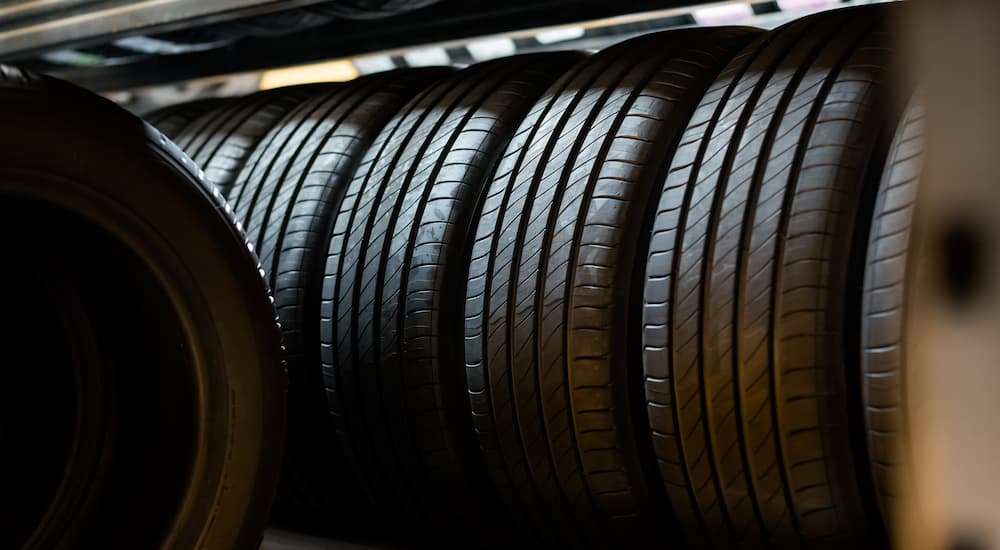
All-Weather Tire Basics
Although technically a type of all-season tire, the all-weather design diverges in multiple ways. The biggest and most obvious distinction is on the sidewall. There, you’ll find the Three-Peak Mountain Snowflake Symbol, or 3PMSF. It’s an ASTM designation indicating that the tire meets a minimum standard for traction when accelerating and braking on snow-covered roads. Qualifications include accelerating on a surface covered in packed and loose snow with 10% more traction than a reference all-season tire.
This performance is achieved through a combination of a more aggressive tread pattern with increased sipping and a softer rubber compound to grip the road. While these tires are not officially snow tires or winter tires, they do provide some of the same benefits. Effectively, all-weather tires fall partway between a regular all-season and a winter tire.
Pros of All-Weather Tires
- An all-weather tire will do much better in light-to-moderate snow and ice than an all-season tire. It might still not be enough for the most extreme winter environments, but it’s more than enough for most winter situations, making them true four-season tires for many drivers.
- The tires also tend to do better in below-freezing weather and on wet roads, making them better for regions with very cold winters or mild conditions year-round, as well as a tire you can push a little harder in those conditions when you need to.
- Since ASTM officially tests and approves all-weather tires (except for Goodyear, which has a trademark to call select tires “all-weather”), you can be assured of more consistent and predictable performance across different brands.
Cons of All-Weather Tires
- The softer compound will wear out faster than the harder compound in an all-season tire, requiring more frequent replacements.
- The increased flex can be problematic in hot weather, leading to reduced grip and an increased likelihood of chunking or peeling. It also generates more road noise.
- The aggressive tread makes overall handling less nimble and responsive on dry roads, and it takes longer to stop.
- All-weather tires tend to cost more than all-season tires, and there are fewer options available.
Choosing Your Year-Round Tire Type
The decision here is simple. The more intense and unpredictable the weather is, the more you should gravitate towards all-weather tires. Their ASTM-approved snow performance makes them better suited for wintery environments and areas that get a lot of rain. Of course, that comes at the expense of performance in dry, hot conditions.
If you live in an area that is consistently warm and only gets snow occasionally, such as most of the Southeast and Southwest, all-season tires are fine. The Mid-Atlantic, central-southern Midwest, and Pacific Northwest are prime all-weather regions with more frequent snowfall. Also, consider all-weather tires in particularly rainy and wet areas, such as along the coast.
Of course, in some regions, there’s no substitute for a set of true winter tires. Here in Northern New England, I wouldn’t dream of trying to make it through a tough winter on the same tires I use in the summer. The same should go for the people of Minnesota, the Dakotas, the Colorado Rockies, and other famously snowy areas.

Drive on the Right Tires
Having a tire that you can bolt on and drive until it’s worn out — with scheduled rotations and other maintenance, of course — can be a huge advantage. You don’t need to spend money on a second set of tires and wheels, find a place to store those additional tires, play a guessing game of when to change them, or decide whether to change them yourself or pay a technician. But you don’t want the convenience of a single tire set to leave you slipping and sliding when the weather takes a turn. That’s why having the right set is crucial. The NHTSA reports that about 11,000 motor vehicle crashes per year are tire-related, which includes having the wrong shoes for the conditions you face.
There are many factors when selecting a tire, including speed rating, load index, and temperature grade. Knowing whether a tire is all-season or all-weather tells you a lot about what it can or can’t do. If you need added traction for snow and ice without swapping tires, and all-weather tires are available for your vehicle, consider them the next time you’re due for a set.