
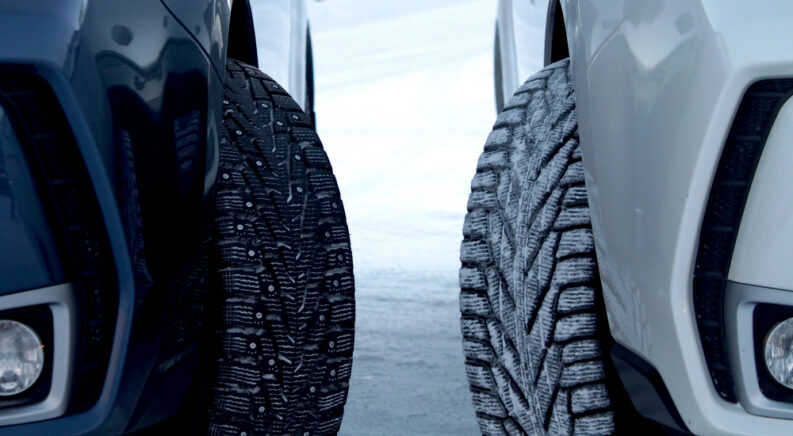
Studded tires have been a winter-weather option for decades, and it appeared the technology had hit its limit. However, as serious car people learned in early March, there’s always room for innovation even in a seemingly mature field. That’s when Nokian Tyres, the Scandinavian company that released not only the first true winter tire in 1934, but the first purpose-built studded tire in 1964, announced its newest product: retractable studded tires. Touted as “on-demand grip,” Nokian is claiming the next generation of the famed Hakkapeliitta brand will change winter driving forever. Are those claims real, or a bunch of cold air? Now that the initial wave of excitement is past, I wanted to take a closer look at these new tires, what they do, and the potential of retractable studs.
What Are Studded Tires?
First, I need to discuss the basics of studded tires, as this technology isn’t exactly free of controversy. They were created to improve traction on icy and snowy surfaces that lack grip. True studded tires have metal studs built into the tread that bite into ice rather than gliding over it. Some studded tires use rubber studs, which are safer but less effective. There is evidence of metal cleats on tires as early as the 1890s, but modern studded tire development began in the late 1950s. Early studs used a tungsten carbide core with a metal jacket, which made them durable enough to withstand constant use.
For many years, drivers who lived in extreme winter conditions used studded tires for a simple reason: they work. By preventing skidding and slippage, studded tires greatly improve safety, especially in their early years when tire compounds were less sophisticated. It’s estimated that in the 1969 to 1970 winter season, up to 50% of snow tires sold in the U.S. were studded. Even today, studs are great for traction and braking in intense winter weather.
However, acceptance of studded tires has cooled for several reasons. The main one is that the metal studs don’t just dig into ice, but also into the road surface itself. As such, studded tires can cause serious pavement damage over time. Because of this, most states have restrictions on when and how drivers can use studded tires. According to data aggregated by World Population Review, 38 of 50 U.S. states allow conditional or seasonal use of studded tires. Five states — Texas, Mississippi, Hawaii, Michigan, and Louisiana — have outright banned them.
Only seven states allow unrestricted use of studded tires: Colorado, Vermont, New Hampshire, Kentucky, Wyoming, New Mexico, and North Carolina. Even in those states, studded tires have some issues. They create a much noisier ride and tend to cost more than studless tires. When there isn’t ice or snow on the roads, studded tires can actually reduce traction.
Finally, advances in winter tire compounds, treads, and durability have narrowed the gap between studded and studless snow tires. Unless you’re regularly dealing with ice-sheet roads and hard-packed snow, the advantages of studded tires often aren’t worth the drawbacks.
How Nokian Retractable Studs Are Different
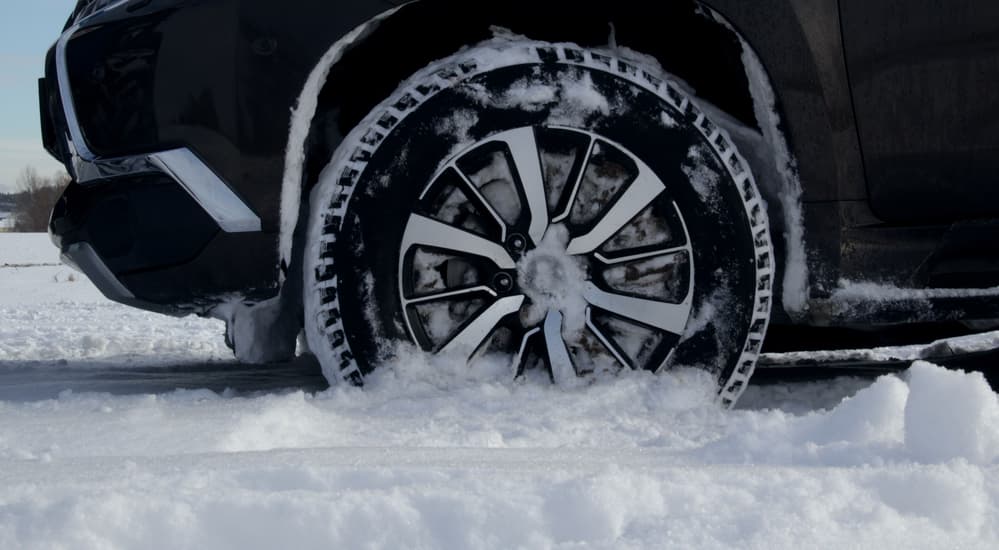
Now, Nokian Tyres is attempting to reinvent the studded tire and give drivers the best of both worlds: tires that dig in when you need them to but work like regular snow tires when you don’t. Nokian has been working on this technology for more than a decade. While retractable-stud tires were seen in James Bond movies, Nokian has finally brought Hollywood to life.
In the normal driving mode, the dual-action studs sit entirely inside the tread. When the vehicle is on a surface that’s below 23 degrees, the pin in the stud’s center is forced outward beyond the tread on all four tires. When the road temperature rises to 41 degrees, the studs automatically retract into the tread. A separate development in tire compounds a few years ago helped make retractable studded tires possible. This new compound stiffens when it comes into contact with a cold surface, such as ice and snow, and softens as the road warms up. The hardening action supports the studs, while the softening action allows them to quickly sink back inside the tread.
The tread pattern and stiff sidewall design of these new tires are taken from the popular Hakkapeliitta 8 SUV studded tire. As for the studs, Nokian based them on the Hakkapeliitta 10 tire it introduced in 2021, featuring double-stud technology: longitudinal studs in the tire’s center for straight-line grip and lateral studs near the edges for cornering grip. Nokian Tyres has dubbed these tires the Hakkapeliitta 01. The name choice signifies that the company doesn’t just see them as a new type of studded tire, but as a new beginning in winter tires. Dealership pre-sales have already begun with a nationwide rollout for the winter of 2026/2027.
Should You Consider Retractable Studded Tires?
These tires certainly have some promise. According to Nokian Tyres, it completed five winters and over 1.25 million miles of testing. The results were 10% more grip on icy roads and 5% more grip on wet roads than the Hakkapeliitta 10. Overall, the tires caused 30% less road wear than regular studded tires. Nokian Tires also claims that at everyday speeds of 38 to 62 mph (60 to 100 km/h), Hakkapeliitta 01 tires are only one decibel louder than typical non-studded tires. This addresses another traditional problem with student tires.
That said, I have several potential concerns. One is pricing, as high-tech tires aren’t cheap. At one retailer I checked, a set of 14-inch Hakkapeliitta 01 tires cost $689.96 plus tax, while some 21-inch tires exceeded $2,500 for a set, and those were on sale. Nokian winter tires are expensive regardless, but be prepared for some sticker shock.
My second concern is “false positives,” where the road is cold enough to activate the studs, but doesn’t have ice or snow on it. As someone who has lived through -40 degree winter days and on temperature-sensitive dirt roads, the possibility is real. There also doesn’t appear to be a way to manually activate the studs, leaving you at the mercy of the tire compound sensing.
As for performance, even with the studs retracting, I have a hard time believing these tires will handle as well on dry roads as non-studded tires. An 18-inch Hakkapeliitta 01 tire has 220 studs. That’s 220 points where the rubber isn’t touching the pavement when they’re retracted.
Then there’s this: how do I know the stud heads won’t become permanently exposed as the tread wears down? I was unable to find a satisfactory answer to this question. Even if that’s not an issue, Nokian admits the life expectancy is only about three winters or 19,000 miles. I’ve had my current non-studded tires for four winters, and they still have plenty of tread left.

A New Option for Winter Driving
I think some drivers will benefit from Nokian Tyres’ new retractable studded tires. They include people who go off-roading in the winter, want the best ice/snow performance, frequently switch between icy and dry roads, or are willing to pay a premium to reduce road wear and noise. On the other hand, if you didn’t need studded tires before, you won’t suddenly need them now that there’s a retractable version. Although Nokian Tyres says it will lobby regulatory agencies to ease restrictions based on the new technology, those are unlikely to change soon.
If you’re on the fence about buying these, my advice is to wait a winter or two. More data on long-term performance will be available by then, and the regulatory situation will have time to play out. Either way, retractable studded tires are an intriguing evolution of a long-standing technology and are worth keeping an eye on.